
- All
- Product Name
- Product Keyword
- Product Model
- Product Summary
- Product Description
- Multi Field Search

 |


| Quantity: | |
|---|---|
GR50-3013
ESCOTT
Product Description
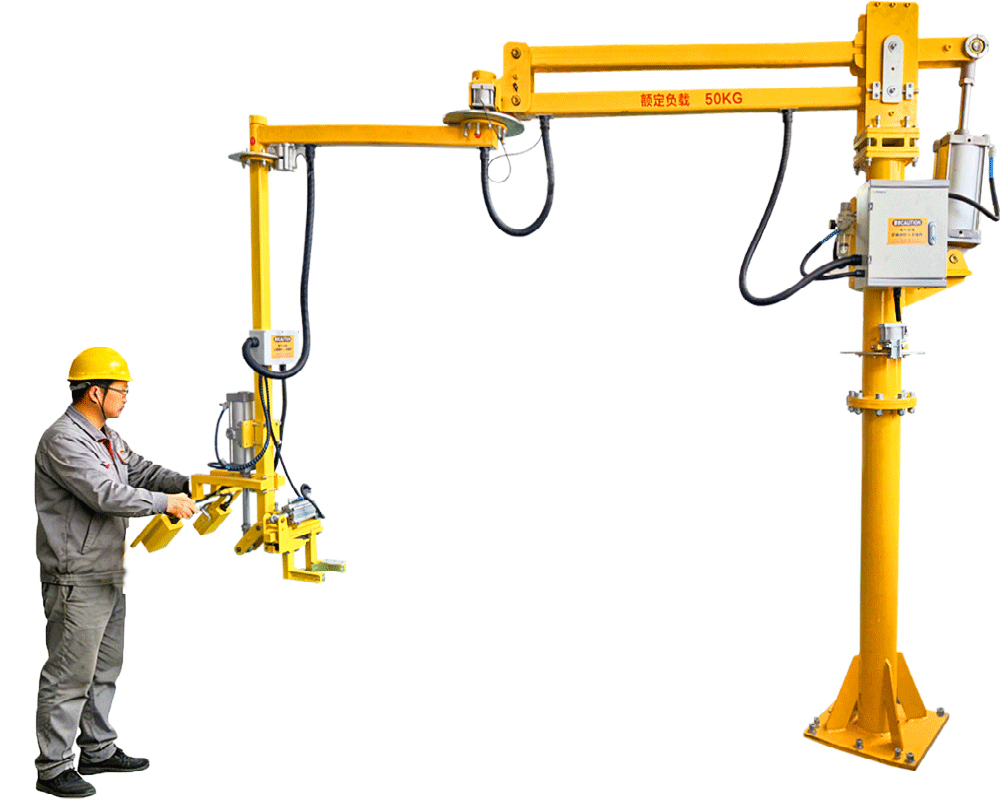
The 50kg pneumatic bearing handling manipulator is a column-mounted lift-assist unit for moving bearings, hubs, ring gears and similar cylindrical parts between production stations. It stands on its own floor-anchored base plate, needs no overhead steel, and combines three functions in one tool: a pneumatic clamp that grips the part on its outer faces, a balance valve that keeps a 50 kg load floating at any working height, and an integrated rotary unit that turns the part through 90 degrees before it is set down. The operator guides the arm with one hand while compressed air carries the weight, so a part that used to need two people and a crane is handled by one person, at a repeatable position, without lifting strain. Column height, working radius, clamp opening and rotation direction are built to the part and the station layout you actually run.
Specifications
| Parameter | Specification |
|---|---|
| Load capacity | 50 kg |
| Drive type | Pneumatic, power-assisted (air cylinder + balance valve) |
| Mounting | Column-mounted, floor-anchored base plate |
| Clamp type | Pneumatic clamp gripper, closing on part outer faces |
| Clamp opening | Customized to your part |
| Part compatibility | Bearing, hub, ring gear and similar cylindrical parts, Customized |
| Rotation | 90 degrees, pneumatic rotary unit, direction Customized |
| Rotation speed | Adjustable via air flow control |
| Working air pressure | 0.6–0.8 MPa |
| Column height | Customized |
| Working radius | Customized |
| Operator control | Handle at tool end, pneumatic valve block on column |
| Surface finish | Powder-coated, RAL colour Customized |
| Safety | Anti-drop protection, overload protection, load rating label on arm, warning decals |
Product Features
1. The weight is carried by air, not by the operator. The pneumatic balance system holds the load in equilibrium at every point of the arm's travel, so the operator feels only a fraction of the real 50 kg and can raise, lower or swing the part with one hand on the handle. Because the load is balanced rather than powered through, the arm stops where the operator leaves it and does not drift or drop when released. The result is a handling motion that follows the operator's hand instead of fighting it, which is what allows the same person to position a heavy part to within a few millimetres.
2. The clamp grips the part, not the machine. Two pneumatic cylinders close a pair of clamp arms symmetrically onto the outer faces of the bearing or ring, so the gripping force is applied where the part is strongest and no load passes through a bore or a machined face. Jaw inserts are fitted with protective pads, so a finished bearing race or a ground hub surface is held without marking. The clamp stays mechanically closed through travel, rotation and placement, and clamp opening is set to the part you handle, with the arms adjustable when you change part size.
3. The 90-degree rotation is built into the tool head. A pneumatic rotary unit turns the clamp assembly 90 degrees, in one controlled motion, while the part is held on all sides by the clamp. This is the movement that manual handling cannot do safely — standing a heavy ring up, or laying it flat onto a fixture — and doing it inside the gripper means the part never rests on the operator's hands during the turn. Rotation direction is set to your process, and the speed is adjusted at the flow control so the turn matches the cycle rather than dictating it.
4. Column-mounted and floor-anchored, so it fits the building you already have. The manipulator carries its own column and base plate and is anchored to the floor with anchor bolts, which means no roof steel, no runway beam and no overhead crane capacity is required to put it into service. It can be installed at a single station, relocated when the line is rebalanced, and it keeps the floor around the workstation clear because the arm reaches over the load instead of occupying the aisle. For plants where a ceiling crane is already at capacity, this is the difference between adding a handling solution and rebuilding the building.
5. Built to the part, with the interface you already use. Clamp opening, column height, working radius, rotation direction and RAL colour are all made to order, so the unit arrives matched to your part instead of being adapted on site. Compressed air is the only utility required, at 0.6–0.8 MPa, which means the machine drops into an existing pneumatic ring main without electrical work at the station. The valve block is mounted on the column and the operating handle at the tool end, so the controls are where the operator's hands already are.

Handle

Fixture

Air tank
How It Works
Compressed air at 0.6–0.8 MPa enters a balance valve mounted on the column. The valve senses the load and keeps it in equilibrium, so the arm holds position at any height and the operator needs only a light force on the handle to move the part up, down or across.
To pick up a part, the operator lowers the clamp over the bearing or ring and closes it with the handle control. Air pressure drives both clamp cylinders, the jaws close symmetrically and grip the part on its outer faces; the clamp then stays closed through the rest of the cycle.
At the workstation, the pneumatic rotary unit turns the clamped part 90 degrees until it faces the fixture or the assembly position. Because the part is held rigidly during the turn, it does not swing, slip or need to be supported by hand. The operator lowers it into place, opens the clamp, and the arm returns for the next part.
If air pressure is lost, the clamp and the load are held by check-valve protection instead of dropping, and the load can be released manually so the part is never trapped in the gripper.
Applications
1. Bearing assembly and fitting lines. Bearings and bearing housings are heavy, round and hard to grip, and they usually have to be presented to a press or a shaft at a specific angle. The manipulator picks the bearing from the stillage, rotates it 90 degrees and holds it in line with the shaft while the operator starts the fit.
2. Gearbox and drivetrain assembly. Ring gears, hubs and clutch housings arrive flat and have to go on vertically. Gripping on the outer diameter and turning inside the clamp removes the manual roll-over, which is where housings usually get chipped.
3. Hub and wheel-end assembly. Hub and brake-drum parts are lifted from pallets, turned to face the spindle and held while fasteners are started — one operator, both hands free at the fastening point.
4. Machine tending and press loading. Where a ring-shaped part must be loaded into a machine at a fixed orientation, the 90-degree rotation delivers it already aligned, which shortens the load stroke and keeps hands out of the tool area.
Warehousing and despatch of heavy round parts. Picking bearings, rings and rolls from racks and stacking them onto pallets or into crates, where the weight per piece is above what a person should lift repeatedly.
5. Foundries and machine shops. Deburring, inspection and marking stations where the part has to be picked, turned to present a face, and put back.


