- All
- Product Name
- Product Keyword
- Product Model
- Product Summary
- Product Description
- Multi Field Search

 |


| Quantity: | |
|---|---|
GR500-3022
ESCOTT
Product Description
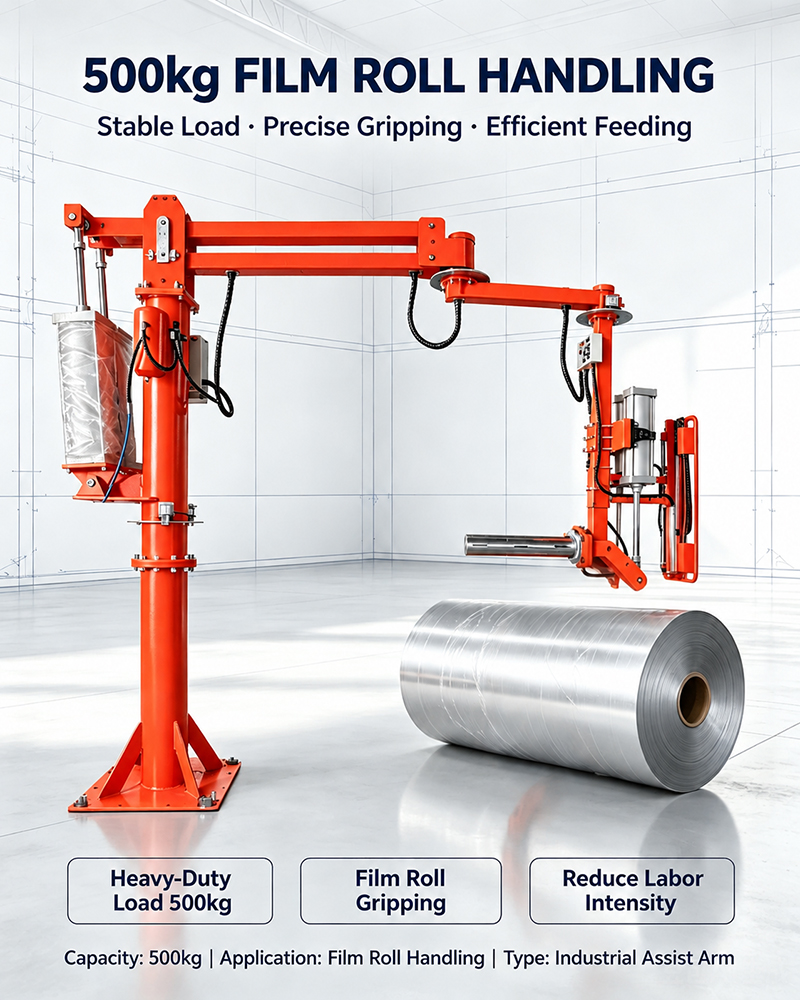
At 500 kg a film roll is past the point where a crew can control it by hand and past the point where slings are safe for the product. It cannot be gripped by the edges like a crate, a sling tightened around it concentrates load on the very surface that has to stay unmarked, and a forklift cannot seat it onto an unwinder shaft with the precision a roll change needs. This pillar-mounted pneumatic manipulator is built for that weight and that job.
The roll is carried from the inside. A horizontal expanding shaft is inserted into the roll core and locked there, so the 500 kg hangs on the core wall and never on the film: no clamp marks, no creases, no crushed edges, no load on the wrapped surface at any point in the cycle. The pneumatic balance cylinder supports the full rated load through the whole working envelope, so the operator moves direction and speed with one hand on the pendant and the weight never reaches a person.
The frame is a single welded structure in orange paint, anchored to the floor beside the line: a bolted base plate, a vertical pillar with a pneumatic balance cylinder, and a two-link horizontal arm on slewing joints that reaches over the machine without a gantry or overhead steel. It runs on ordinary shop compressed air at 0.6-0.8 MPa, with no electric motor, no hydraulic fluid and no servo programming in the load path.
Technical Parameters
| Parameter | Specification |
|---|---|
| Rated load | 500 kg |
| Handling method | Horizontal expanding shaft, inserted into the roll core and locked from the inside |
| Shaft diameter / expansion range | Customized to your roll core |
| Working radius | Customized to the line |
| Lifting stroke | Customized to the line |
| Roll weight / diameter / width | Customized |
| Roll type | PE, BOPP, CPP, PET, stretch, shrink, laminating and printed film |
| Arm structure | Two-link articulated arm on slewing joints |
| Drive type | Pneumatic balance, power-assisted |
| Power source | Compressed air, 0.6-0.8 MPa |
| Operation | Hand-guided control pendant |
| Base | Floor-mounted base, anchored to the floor |
| Finish | Orange painted finish |
| Safety features | Rated load marking on the arm, anti-drop protection on air loss, overload protection, safety warning |
| Certification | ISO, CE |
| Warranty | 1 year |
| Delivery condition | Shipped in sections, on-site assembly and commissioning |
Working Principle
The operator swings the two-link arm over the roll and brings the horizontal expanding shaft level with the core, with the roll standing on a pallet, in a stillage or on the floor.
The shaft enters the core and expands, locking the roll from the inside. From this moment the 500 kg is carried on the core wall, and the film surface is not a load-bearing face.
The pneumatic balance cylinder takes over the weight, so the roll floats at the operator's hand at every height and at every reach of the arm.
The operator guides the arm to lift the roll clear and travel it across the floor, controlling direction and speed only, with no lifting posture and no second person at the far end of the roll.
The roll is aligned with the target — an unwinder or rewinder shaft, a pallet, a rack or a stillage — using the short travel of the hand-guided arm rather than nudging a 500 kg load into place.
The shaft contracts and withdraws, the arm returns to balance, and spent cores are removed in the same cycle with the same head.
Product Features

1. True 500 kg rated load, air-balanced throughout. The pneumatic balance cylinder supports the rated load across the whole working envelope, so a 500 kg roll feels light whether it is up, down, fully extended or close to the pillar. Balance is maintained as the arm travels instead of being set once at one height, which is what makes fine positioning at this weight possible by hand. Rated capacity is marked on the machine and the structure carries overload protection, so a misjudged roll cannot load the frame beyond its rating.
2. Core-insertion shaft, so the film is never the gripping face. A horizontal expanding shaft enters the roll core and locks the roll from the inside, which means the film surface, the edges and the lap ends are not where 500 kg hangs. Rolls arrive at the next process without clamp marks, creases or crushed edges, and cores stay round enough to fit the unwinder shaft afterwards. Shaft diameter and expansion range are machined to your actual core rather than to a nominal size, and the shaft is cantilevered so the roll can be picked up from the side without lifting it over the head.

3. Two-link arm on slewing joints, reaching over the line. The arm is built as two horizontal links on slewing plates, so the head can travel in an arc over the machine, the pallet area and the aisle without a gantry or overhead rail. Working radius and lifting stroke are calculated from your layout and your machine heights before production, which keeps the reach useful instead of generic. Because the arm folds rather than extends straight out, the roll can be brought close to the pillar during travel and swung out only at the point of placement, which keeps the moment load on the base low at 500 kg.
4. One hand on one control pendant. Raise, lower, travel and shaft expansion and release are controlled from a single pendant, positioned for your operator and the height of your machines. The pendant transmits direction and speed only, so the operator's hand stays relaxed through a shift and the roll follows the hand rather than the other way round. Operators are productive after a short instruction rather than a training course, and the arm can be brought to within a few millimetres at the machine.

5. Pneumatic drive on ordinary shop air. The handling function runs on compressed air at 0.6-0.8 MPa, with no electric motor, no hydraulic fluid and no servo programming involved in carrying the load. Running cost is compressed air rather than a maintenance contract, components are standard serviceable pneumatic parts, and the wear parts are reachable from floor level so routine service does not require dismantling the arm. Where the plant already has an air line at the machine, installation is a mechanical fixing job rather than an electrical project.
6. Floor-mounted base with safety built in as standard. The machine is anchored to the floor beside the line, so the working envelope stays fixed relative to the machine it serves and the floor in front of the line stays clear. A bolted base plate also means a 500 kg roll cannot push the arm out of position or creep while the operator is aligning it. Rated load marking, anti-drop protection on air loss, overload protection and safety warnings are part of the machine rather than options added later, so a broken hose never becomes a dropped roll.
Application Scenarios
Blown film and cast film production — taking finished rolls off the winder and placing them onto pallets, racks or the floor without surface damage.
Printing and laminating lines — loading heavy film rolls onto unwinders at the start of a run and lifting spent cores out at the end of it.
Slitting and rewinding — handling master rolls into the slitter and moving finished reels out without edge damage or core deformation.
Bag making and converting — feeding rolls into converting machines and changing them at the rate the machine can run, without waiting for a forklift.
Coating, metallizing and battery separator lines — roll handling where the web surface must not be touched and contact or dust contamination counts as a defect.
Warehouse and transfer areas — moving stretch, shrink and printed rolls between racks, pallets, stillages and loading bays with one operator.