
- All
- Product Name
- Product Keyword
- Product Model
- Product Summary
- Product Description
- Multi Field Search

 |


| Quantity: | |
|---|---|
GR50-3012
ESCOTT
Product Description
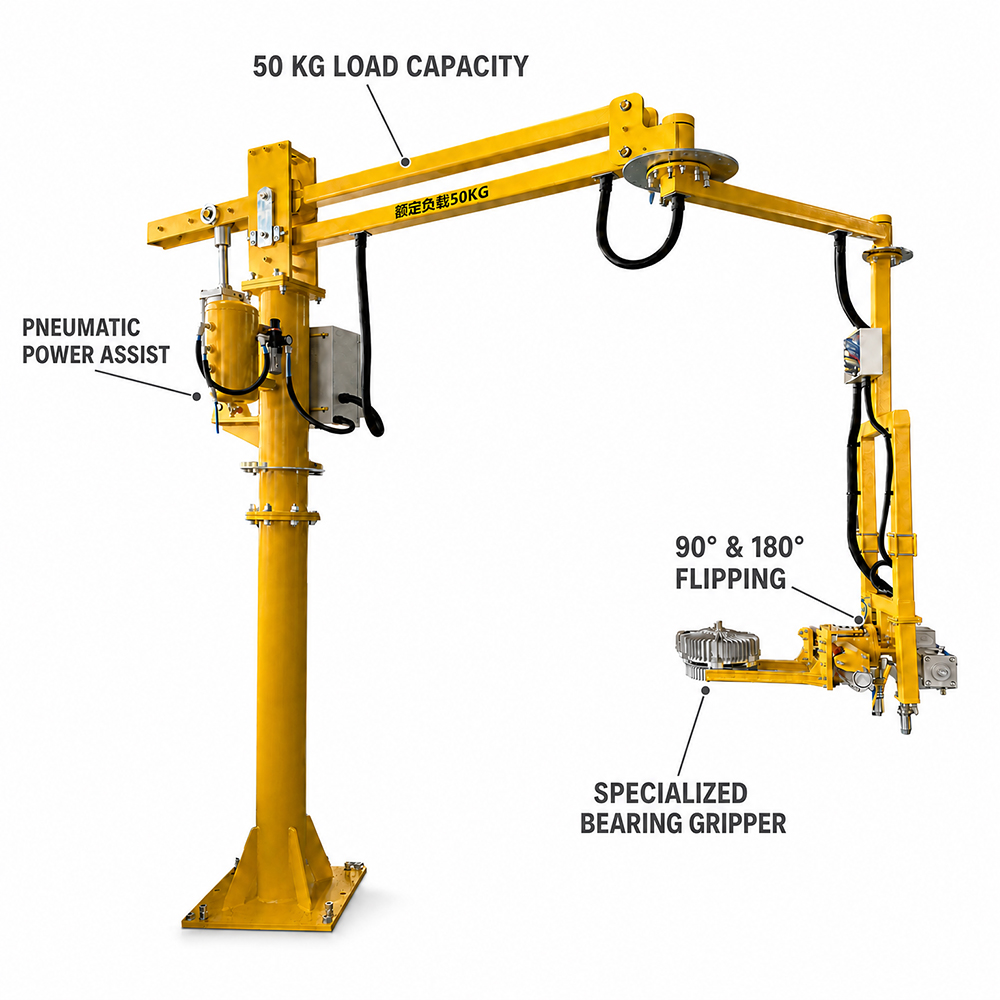
This 50kg pneumatic manipulator is a floor-anchored pillar unit with an external clamp gripper, built for one job: taking cast gear housings, gear blanks and similar round castings off a stillage, through the machine and onto the next station without a two-man lift or a crane. A horizontal air cylinder drives a rack-and-pinion pair along two linear guides, so both jaws close together from the outside and take the casting on its outer wall, holding it square without gripping a bore or a machined face. A balance valve carries the full 50 kg in the air, so one operator moves a finished casting with a light hand on the dual grips: pick up, raise, swing the arm to the fixture, brake, set down at the same height every cycle. The unit needs compressed air at 0.6–0.8 MPa and a floor anchor — no roof steel, no crane capacity, no electrical work at the station — and clamp opening, column height, working radius and jaw pads are made to your part.
Technical Parameters
| Parameter | Specification |
|---|---|
| Model type | Pneumatic power-assisted manipulator, external clamp type |
| Load capacity | 50 kg |
| Drive | Compressed air, air cylinder + balance valve |
| Gripping method | External clamp gripper, two jaws closing from the outside, rack-and-pinion synchronised, running on linear guides |
| Clamp opening | Customized to your part |
| Workpiece | Cast gear housings, gear blanks and similar round castings, Customized |
| Workpiece size range | Customized (set by clamp opening and jaw height) |
| Mounting | Pillar-mounted, floor-anchored base plate, anchor bolts |
| Arm motion | Lift and lower, column slewing with brake and limit stop |
| Operator control | Dual grips at tool end — left: E-stop, balance, limit, rotate, pick up, unload; right: brake, up, down, pick up, unload |
| Working air pressure | 0.6–0.8 MPa |
| Air consumption | Customized (depends on cycle and part weight) |
| Column height | Customized |
| Working radius | Customized |
| Surface finish | Powder-coated, RAL colour Customized |
| Load rating | 50 kg marked on the arm |
| Safety devices | Anti-drop protection, overload protection, load rating label, warning decals |
Working Principle
Compressed air at 0.6–0.8 MPa enters the valve block mounted on the column and is fed to two circuits: the balance circuit that carries the arm, and the clamp circuit that drives the gripper.
In the balance circuit, the balance valve compares the load with the air pressure in the lift cylinder and keeps the two in equilibrium. When the operator pushes the grip up or down, the valve adds or releases air until the arm follows the hand; when the hand stops, the valve holds that position. The load therefore floats rather than hangs, and the force needed at the grip stays small whatever the part weighs.
In the clamp circuit, the operator presses pick up and air is admitted to the clamp cylinder. The piston rod pushes a rack, the rack rotates the pinion at the centre of the head, and the pinion drives both jaw carriages along the linear guides so the jaws close symmetrically on the outer wall of the casting. The clamp stays mechanically closed through lifting, slewing and set-down because the cylinder is held under pressure for the whole cycle; unload reverses the airflow and the jaws open together.
The column slews on its bearing with the brake released, and the brake locks the arm in position when the operator needs the part held at the machine. The limit stop interrupts travel before the arm reaches the enclosure. If air pressure is lost, check-valve protection keeps the arm and the clamp from releasing the load, and the clamp can be released manually so a part is never trapped in the head. When the next casting is a different size, the jaw opening is reset to that part and the cycle repeats without changing the head.
Product Features

1. The weight is carried by air, not by the operator. A balance valve on the column senses the load and holds it in equilibrium at every point of the arm's travel, so the operator feels only a fraction of the real 50 kg and can raise, lower or swing a casting with one hand on the grip. Because the load is balanced rather than driven through, the arm stops where the operator leaves it instead of drifting on its own, which is what makes a repeatable set-down height possible. For a cast part that has to be presented to a fixture at the same level every cycle, this removes the small height corrections that cause mis-loads and chipped edges.
2. Both jaws move together, so the part is centred, not pushed aside. The clamp is driven by one horizontal cylinder acting on a rack, and the rack turns a pinion that moves both jaw carriages along two linear guides in opposite directions at the same rate. The result is a symmetric, parallel closing motion: the casting is picked up on its centreline rather than being shoved toward one jaw, and the gripping force is balanced across the part. The two guides also take the turning moment of a heavy off-centre casting, so the jaws stay square to the part instead of cocking under load — the failure mode that makes cheaper grippers drop round castings on the swing.

3. Gripping the outer wall is what makes castings practical to handle. As-cast surfaces are rough, blasted or shot-blasted and often out of tolerance, so a bore-referenced gripper or a vacuum head has nothing reliable to hold: bores vary, and a vacuum cup will not seal on a sandy cast skin. This gripper closes on the outer wall — the one surface every casting has, whatever its machining state — so the same head handles raw castings from the foundry and finished parts at assembly. Jaw pads are fitted to protect machined diameters and to take up the surface variation of raw castings, and the opening is set to your part so the jaws close on the wall, not on the fins.
4. A floor-anchored column fits the building you already have. The manipulator carries its own column and base plate and is fixed to the floor with anchor bolts, which means no roof steel, no runway beam and no crane capacity has to be found before it can work. It can be installed at a single station, unbolted and moved when the line is rebalanced, and it keeps the aisle clear because the arm reaches over the load instead of occupying floor space beside it. For plants where the overhead crane is already committed, this is the difference between adding a handling solution and rebuilding the bay.

5. Controls sit under both hands, with the arm lockable where you leave it. Each side of the tool end carries its own grip panel, so the operator works right- or left-handed without swapping position: pick up and unload on both sides, plus balance, limit and rotate on the left, brake, up and down on the right, with the E-stop in reach of either hand. The brake locks the arm and the slewing column in place, so a part can be held at the fixture while both hands are used to start fasteners or check location, and the limit stop keeps the arm out of the machine enclosure and off the operator. Because every function is a lever under the hand that is already holding the load, the operator never has to let go of the part to move it.
6. Made to the part and the station, on air alone. Clamp opening, jaw height, column height, working radius and RAL colour are built to the casting and the cell layout, so the unit arrives matched to the job instead of being adapted on site. Compressed air at 0.6–0.8 MPa is the only utility, which lets the machine drop onto an existing pneumatic ring main without an electrical connection at the station. Dimensions are confirmed from your part drawing and pick-and-place heights before production, and returned as a dimensioned drawing for approval.
Applications
1. Gear housing and gearbox machining lines. Cast gear housings arrive from the foundry and have to be presented to a fixture at a fixed height and orientation, then taken off again after machining. The manipulator lifts the housing off the stillage, swings it to the machine and holds it in place while the operator locates it, so the load is carried by air rather than by the person setting it.
2. Foundry cleaning, deburring and inspection. Castings coming out of shot blast or off the fettling bench are heavy, rough and handled dozens of times a shift. Gripping the outer wall means the head does not care whether the casting has been machined yet, and the operator can turn the part to present a face without lifting it off the support.
3. Gearbox and drivetrain assembly. Ring gears, hubs and bearing housings are picked from stillages and set onto shafts or into casings at a controlled height. The brake holds the part at the assembly point with both hands free for fasteners, which is where a manual lift usually ends in a dropped or cocked part.
4. Press and machine loading. Where a round casting has to be loaded into a press, a broaching machine or a CNC fixture, the arm delivers it to the load point and holds it there while the operator confirms location. The limit stop keeps the arm from travelling into the tool area, and the part never rests on the operator's hands inside the machine.
5. Palletising and despatch of cast parts. Finished castings are stacked onto pallets or into crates at a height that changes with every layer. Balance valve control lets the operator place each part onto the layer below without a crane sling or a two-man lift, at the same set-down height cycle after cycle.


